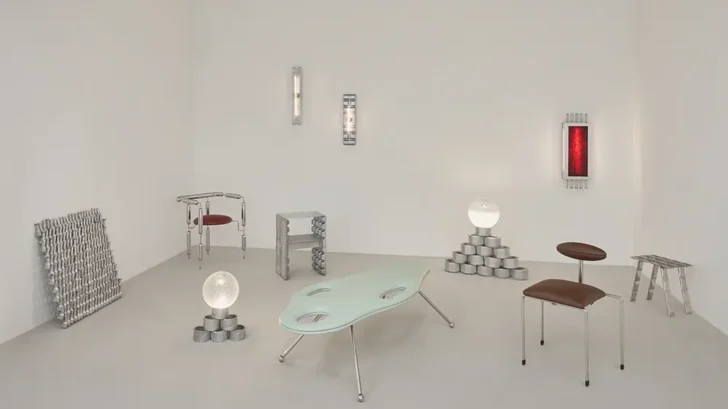

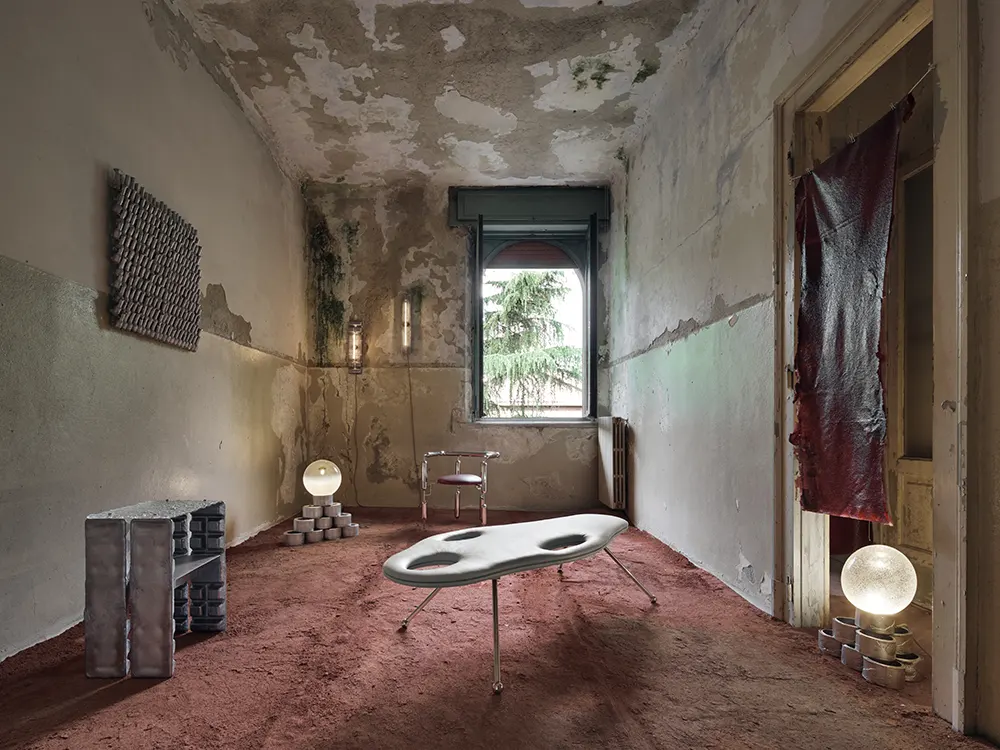
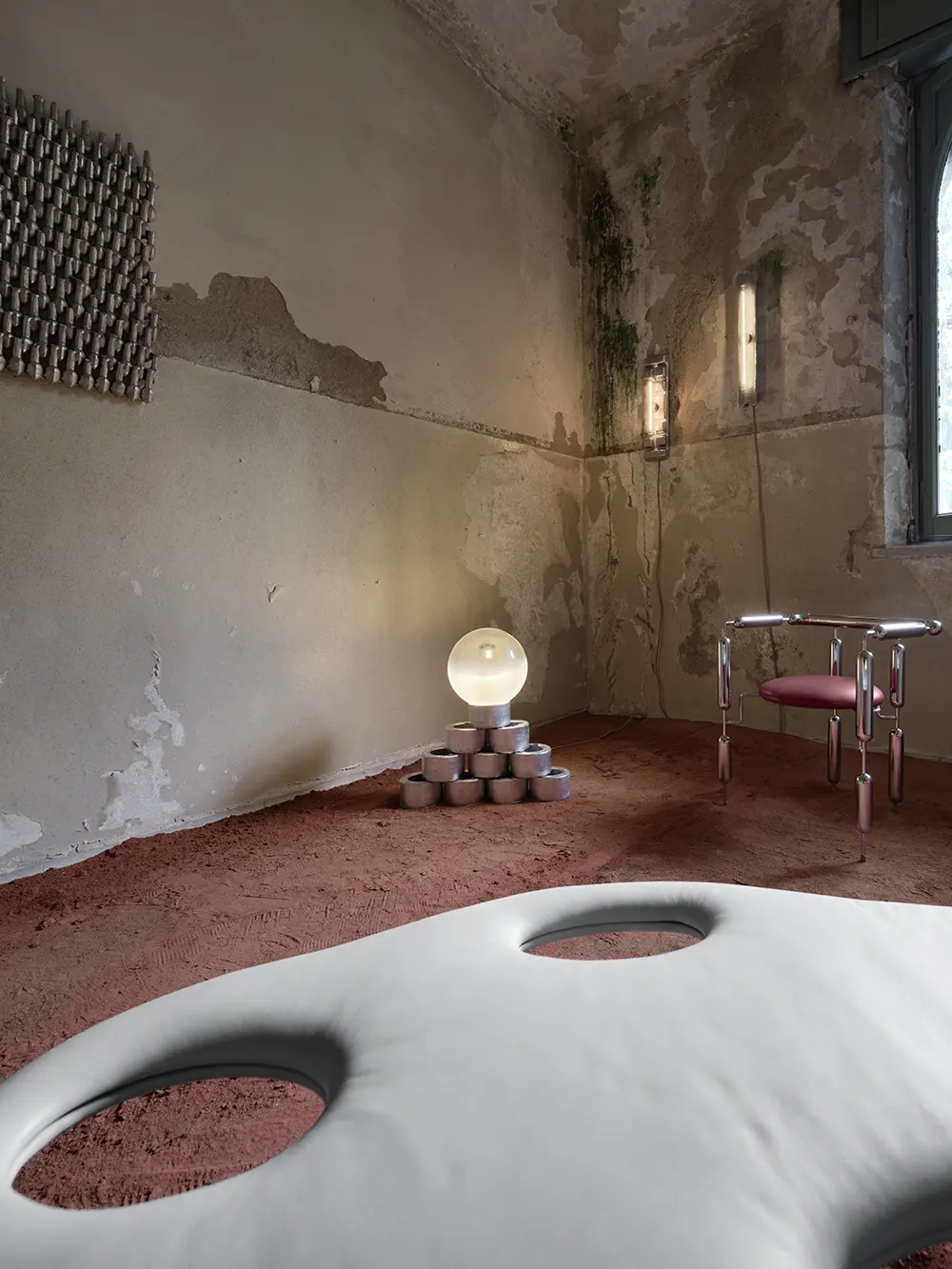
Mati Sipiora and Ola Jakuć discuss Summer on Mars with ARCHISCENE Magazine, an exhibition presented during Milan Design Week 2026 as part of Alcova. Conceived as an alternative reality suspended between the real and the imagined, the project draws from retrofuturistic visions of Mars, modernist optimism, and post-anthropocentric thinking. Through lighting objects, sculptural structures, furniture, scent, crushed brick flooring, and atmospheric interventions, the exhibition builds an environment where domestic forms enter a speculative Martian setting.
INTERVIEWS
The project brings together two distinct design practices through contrast, with Sipiora’s structural precision placed in dialogue with Jakuć’s organic and intuitive approach to light, material, and perception. Mati Sipiora presents the new Lovecraft chaise longue and Zeppelin chair, alongside earlier works such as the Poodle armchair, Pluto table, and Cosmic stool. Ola Jakuć contributes pieces including Planet of Dew, Planet of Mist, Eternal Orchard, Water Discovery, and Superorganism. In this interview, Sipiora and Jakuć discuss inner summer, displaced reality, material experimentation, sensory space, and how objects can shift meaning when placed inside an unfamiliar world.
The idea of an “inner summer” runs through the exhibition as an emotional anchor. What informed the decision to place that sense of warmth within a setting usually depicted as cold?
O: We wanted to play with imagination, but also with contradictions – to juxtapose them and treat them almost like a game. We speak about summer, but it’s summer on Mars. Is it even warm there? The whole exhibition began with a series of “what if?” questions. What if our understanding of warmth, comfort, or nature could exist in completely different conditions? For example, sunsets on Mars appear blue rather than red. For us, this was a beautiful starting point for questioning our structured habits and familiar perceptions. There was also a more emotional layer to it. Summer usually makes us feel better – we have more energy because there is more light. Since light is such an important material in my practice, I wanted to recreate this feeling of warmth through light itself. But we are still on Mars, so perhaps it is not warmth in the way we are used to experiencing it on Earth. It is produced through different means, with a slightly unfamiliar emotional temperature. From there, I began working with motifs that I associate with summer – orchards, mist, dew, water, insects – and transforming them into something more cosmic, more Martian.
M: I think Ola described it beautifully through the idea of contradiction. For me, the “inner summer” was more about an emotional state than actual temperature. Even in cold or unfamiliar environments, we still search for warmth, intimacy, and connection. Setting the exhibition on Mars allowed us to detach summer from its usual meaning and treat it more like a memory or a feeling that we carry within ourselves. In that sense, the contrast between coldness and warmth became a way of speaking about human perception and emotional adaptation.
Even in cold or unfamiliar environments, we still search for warmth, intimacy, and connection.
The project is described as a displacement of reality rather than an escape. How did this approach shape the way visitors experienced the objects?
O: It can be understood on multiple levels. First of all, reality itself is something we experience through our senses, and perception is always shaped by them. With SUMMER ON MARS, we wanted the space, objects, scent, sound, and lighting to work together as one coherent environment – a physical translation of the vision we had been discussing for months. At the same time, we were also questioning what “reality” meant in this particular context. The exhibition was presented during Milan Design Week at Alcova, so despite its speculative and abstract point of departure, it still remained grounded in the language of contemporary design. The objects were functional, tangible, and connected to everyday use. So rather than creating an escape from reality, we were interested in slightly shifting it – creating a situation where familiar functions and recognizable forms existed within a different emotional and perceptual framework.
M: For us, it was important to place everyday objects – balancing between design and art – within an environment that felt completely unfamiliar. We wanted the entire space to evoke the atmosphere of Mars through every detail: light, materials, sound, and spatial composition. At the same time, the objects themselves were meant to naturally belong to this imagined reality. We liked the idea that they could exist both in a domestic context and within a speculative Martian landscape, almost blurring the line between the familiar and the unknown. Especially for the exhibition, I designed the Lovecraft chaise lounge – an organic form that looked almost as if it was walking across the surface of the red planet. For me, it was also a playful experiment with form and convention. It is technically a piece of furniture, but at the same time it feels slightly alive, as if it wanted to escape or came from another dimension. That duality reflects our approach to design quite well.
Your styles are very different, one structural and precise, the other organic and intuitive. Is there a specific point where your two worlds meet, or did they remain in constant contrast?
O: I think the contrast between our works is probably the first thing people notice, but at the same time I also see many similarities in the way we approach making. The most obvious common point is metal as a material, but beyond that, we both allow the material itself to guide us. Our objects come from personal fascinations that are then translated into form through a very intuitive process. In a way, I think the objects also reflect our personalities quite strongly – they reveal different sensitivities, temperaments, and ways of experiencing the world. I also find our backgrounds interesting in relation to this collaboration. We come from opposite ends of Poland and, for some time, studied at the same university. Maybe that was one of the first moments our worlds crossed – perhaps unconsciously, somewhere in the corridor – even though we actually met relatively recently. What feels important to me is that, despite developing our practices separately, we arrived at a very similar understanding of authorship and making. That is what allows us to collaborate through dialogue and contrast while still preserving the individuality of each practice.
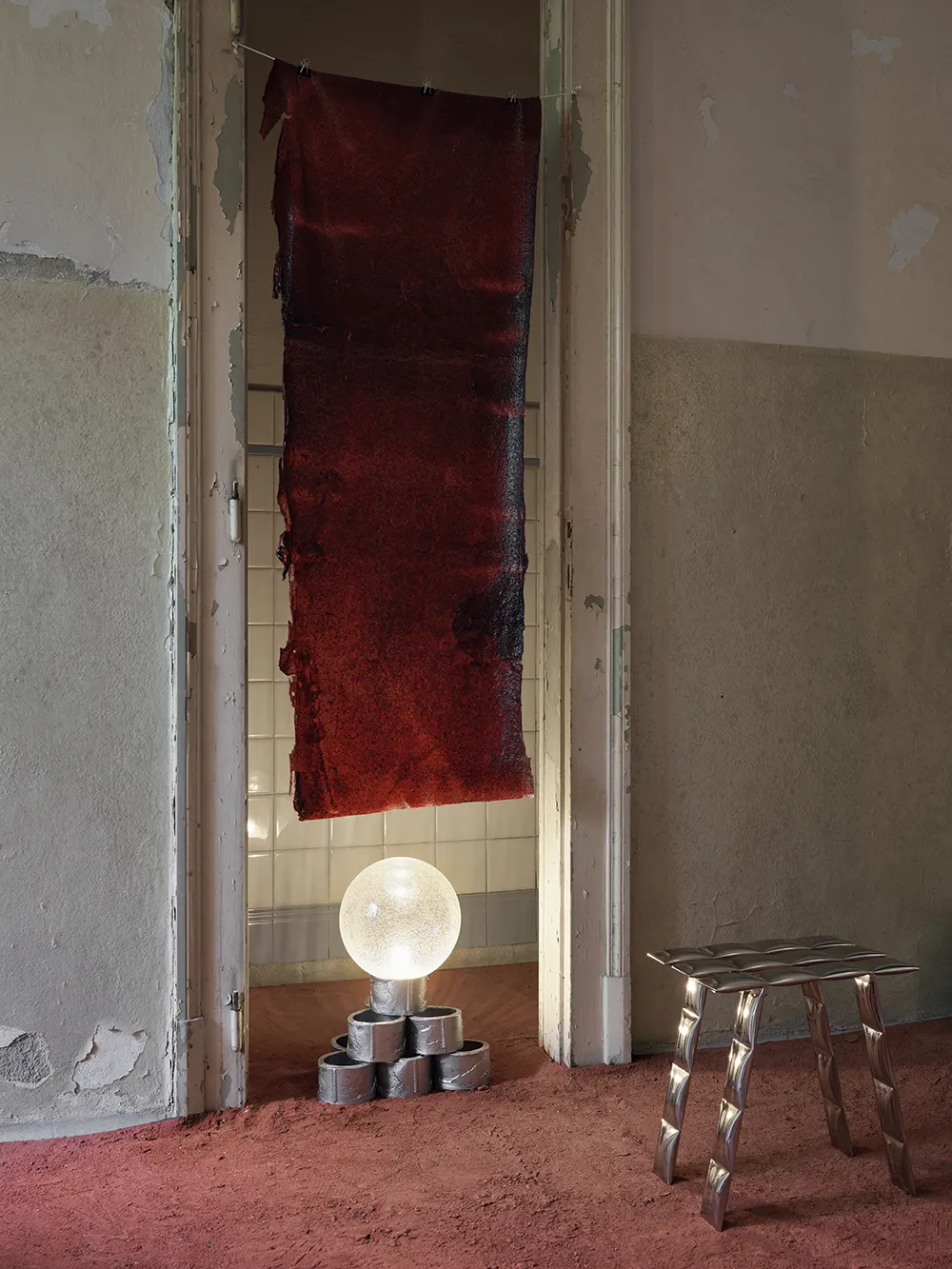
M: I think the contrast is actually the part I enjoy most about our collaboration, and it gave me a satisfaction while creating this exhibition. Our works are completely different, yet they still communicate with one another. What connects us is metal, but even there we work with opposite materials and approaches. Ola works with aluminium, a softer, more malleable material that can be cast into very organic forms. My practice is based more around stainless steel, which I weld, cut, and shape in a much more precise, almost surgical or futuristic way. I find this tension between the two approaches very inspiring. One feels fluid and intuitive, the other more structural and controlled, but together they created a dialogue that became an important part of the exhibition itself.
The Lovecraft chaise longue by Mati Sipiora is inspired by cosmic horror. How was an object meant for relaxation designed to also feel unfamiliar?
The Lovecraft chaise longue came from my fascination with the stories of H.P. Lovecraft and the atmosphere of cosmic horror. There was also a sense of humor behind it, this idea that on Mars, even objects designed for rest might look as if they want to escape from us. I wanted the piece to feel slightly inaccessible, almost like an alien organism or a futuristic algae form. You can still recognize soft surfaces and shapes that invite the body to sit or recline, but at the same time there is something unfamiliar and unsettling about it. That contrast was intentional. I was interested in creating a kind of grotesque tension between comfort and discomfort, familiarity and otherness.
With the Zeppelin chair, the idea of levitation comes into focus. How was a heavy, sculptural object shaped to feel as if it transcends gravity?
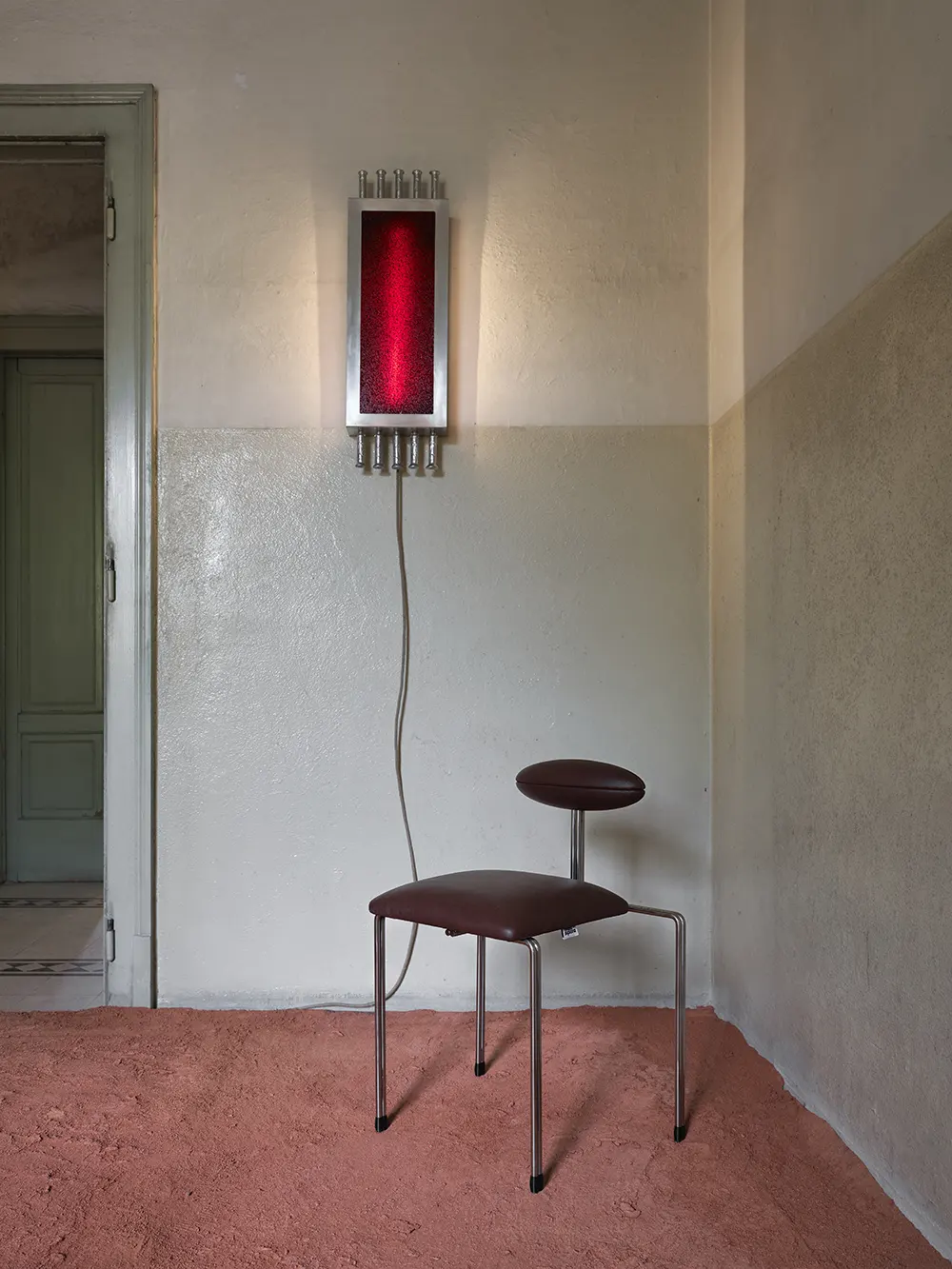
The Zeppelin chair was inspired by airships and by humanity’s fascination with flight and the dream of levitation. From the beginning, I wanted the object to feel light and elegant despite being made from metal. A very important detail for me was the leather cushion placed on the backrest, which subtly references the form of an airship and becomes the visual focal point of the chair. I spent a long time searching for the right proportions and the right balance between leather and metal so the whole piece would feel soft, inviting, and almost floating. I was also very interested in the construction itself, especially the intersecting double legs made from paired steel rods that cross each other in a logical and structural way. It became a kind of formal experiment for me.
Setting the exhibition on Mars allowed us to detach summer from its usual meaning and treat it more like a memory or a feeling that we carry within ourselves.
Earlier works such as the Poodle armchair appeared alongside new premieres. Did they take on a different meaning once placed within this Martian context?
The Poodle armchair is a very important piece within my practice and also a very personal project for me, so it felt natural to include it within the Martian environment of the exhibition. I think it fits this futuristic narrative very well because, in a way, the object already looks like a visitor from another planet. Its construction resembles polished capsules or metallic forms from another dimension, so placing it within the Mars setting gave it an entirely new layer of meaning. What interests me about the Poodle chair is that it constantly changes depending on the context in which it is shown. I believe this project will continue to evolve through future exhibitions because it is very difficult to place within one specific style or design movement. It goes slightly against expectations, and because of that it can exist equally well in domestic interiors, gallery spaces, or even within an imagined Martian landscape.
Across Ola Jakuć’s work, light operates as a central element. When did light begin to function as a material rather than a condition?
O: It was a long process. If I had to place small flags along that journey, one of the first important moments was during my Erasmus exchange at Hochschule Hannover, where I studied Design and Media. I enrolled in a light design course, and as part of it we visited the Light Art Museum in Unna. I remember feeling a very immediate spark there – a sense that this was something I wanted to pursue further. Later, my fascination with electronic music became equally important. I dreamed about connecting these two worlds somehow. My first attempts at working with design through multiple senses started during my studies at Design Academy Eindhoven. Afterwards, I designed lighting objects for a club in Amsterdam, and later, thanks to friends from Berlin, I began creating light scenographies for a niche electronic music festival. That was probably the moment when I truly understood how strongly light can shape spatial experience and influence the way people emotionally perceive a space. At the same time, because of my background in art and design, I have never thought about light purely in technical terms. For me, it is primarily about atmosphere, form, perception, and the relationship between light and material. Now these experiences naturally flow back into my design practice – although honestly, at this point all these worlds have become intertwined, and ideas move freely between them.
Eternal Orchard introduces a biodegradable material developed in collaboration with scientists. How did that collaboration shape the final object?
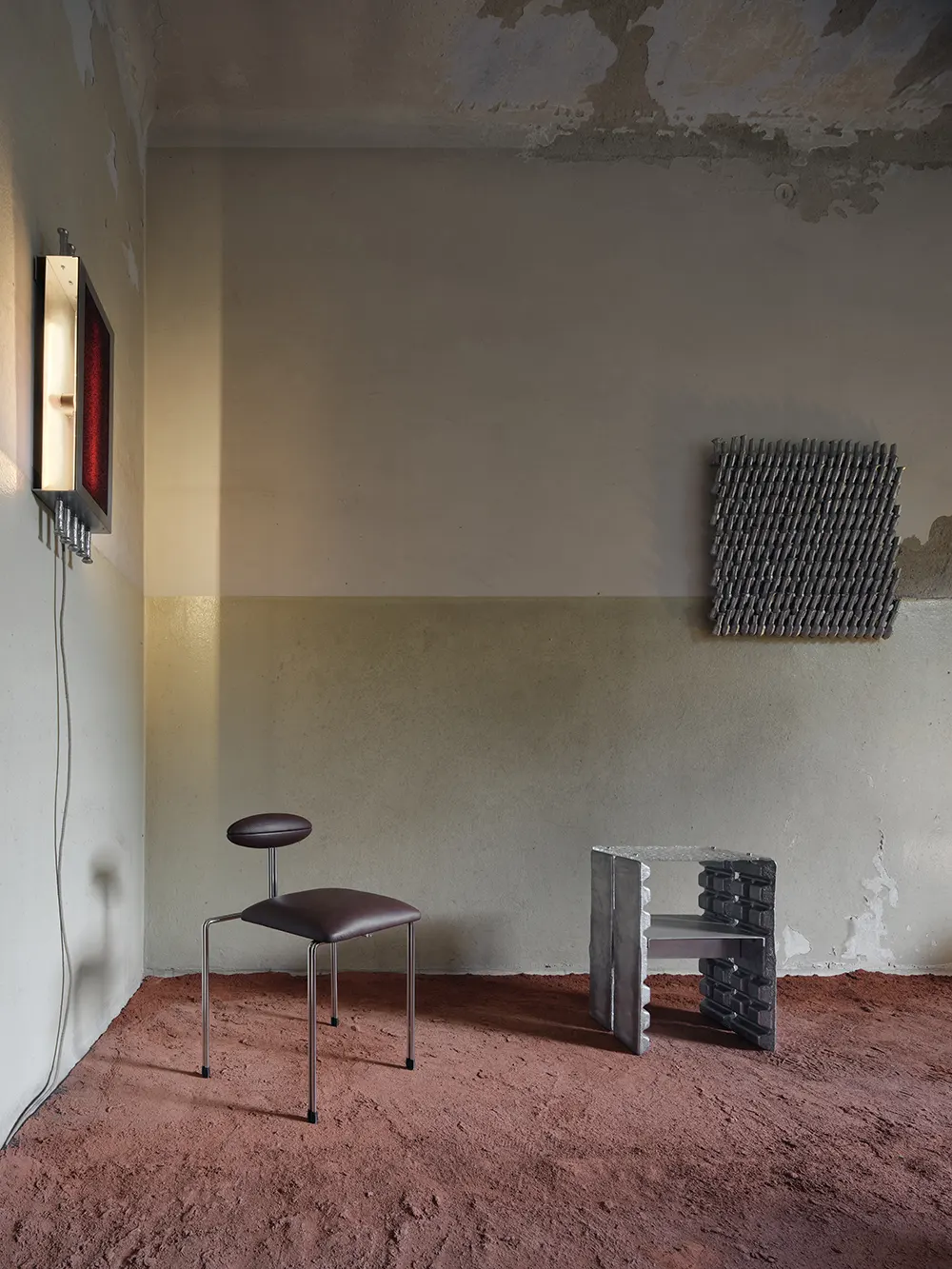
O: Working with researchers from other disciplines is something I deeply value. I see design itself as a field that naturally connects different kinds of knowledge – technical, artistic, scientific, and social. Because of that, seeking experiences outside of the field has always felt very natural to me. For Eternal Orchard, I collaborated with a team from Białystok University of Technology – Aneta Sienkiewicz and Małgorzata Kowczyk-Sadowy – who developed a fully biodegradable hardened biomaterial made from blackcurrant.
The collaboration directly shaped the final object because the material itself determined many of my decisions. The moment I received the samples, I became fascinated by the way they interacted with light. Without illumination the material appears almost black, but once light passes through it, deep red tones begin to emerge and its entire character changes. That transformation became the central element of the piece. I placed light behind the material and designed the object around this gradual shift of color and perception. In a way, the work became a dialogue between organic matter, technology, and sensory experience. The aluminum cast details at the top and bottom function almost like a final seal – emphasizing my ongoing interest in the relationship between natural and industrial processes.
The exhibition became a space onto which visitors projected their own experiences, sensitivities, and associations.
Throughout the exhibition, the objects read in relation to one another as part of a shared system. Were they conceived this way from the beginning, or did that connection develop over time?
O: The way the objects eventually entered into dialogue with one another was actually unexpected for us as well. From the very beginning, we gave each other a great deal of independence and did not interfere in one another’s individual processes, even though we were creating the exhibition together. We had several conversations early on to establish a shared framework for the collaboration, but afterwards each of us developed our own path independently. We only saw the entire exhibition together about a month before presenting it at Alcova, and we were genuinely surprised by how many relationships emerged between the works – especially through color, atmosphere, and material presence. It almost felt as if every decision had been made collectively from the start. I think this kind of trust and understanding happened naturally at a certain point, and if we had tried to plan everything from the very beginning, it probably would not have worked in the same way. We started with a shared intuition and simply followed it.
M: The starting point for us was actually the contrast between our works. We knew from the beginning that we create very different kinds of objects, and that the collision of these two worlds could produce something interesting. Of course, we both had a general vision of what we wanted to show and what kind of atmosphere we wanted to build, but a lot of the process remained very intuitive. We worked quite independently and trusted that the pieces would somehow find their place together.
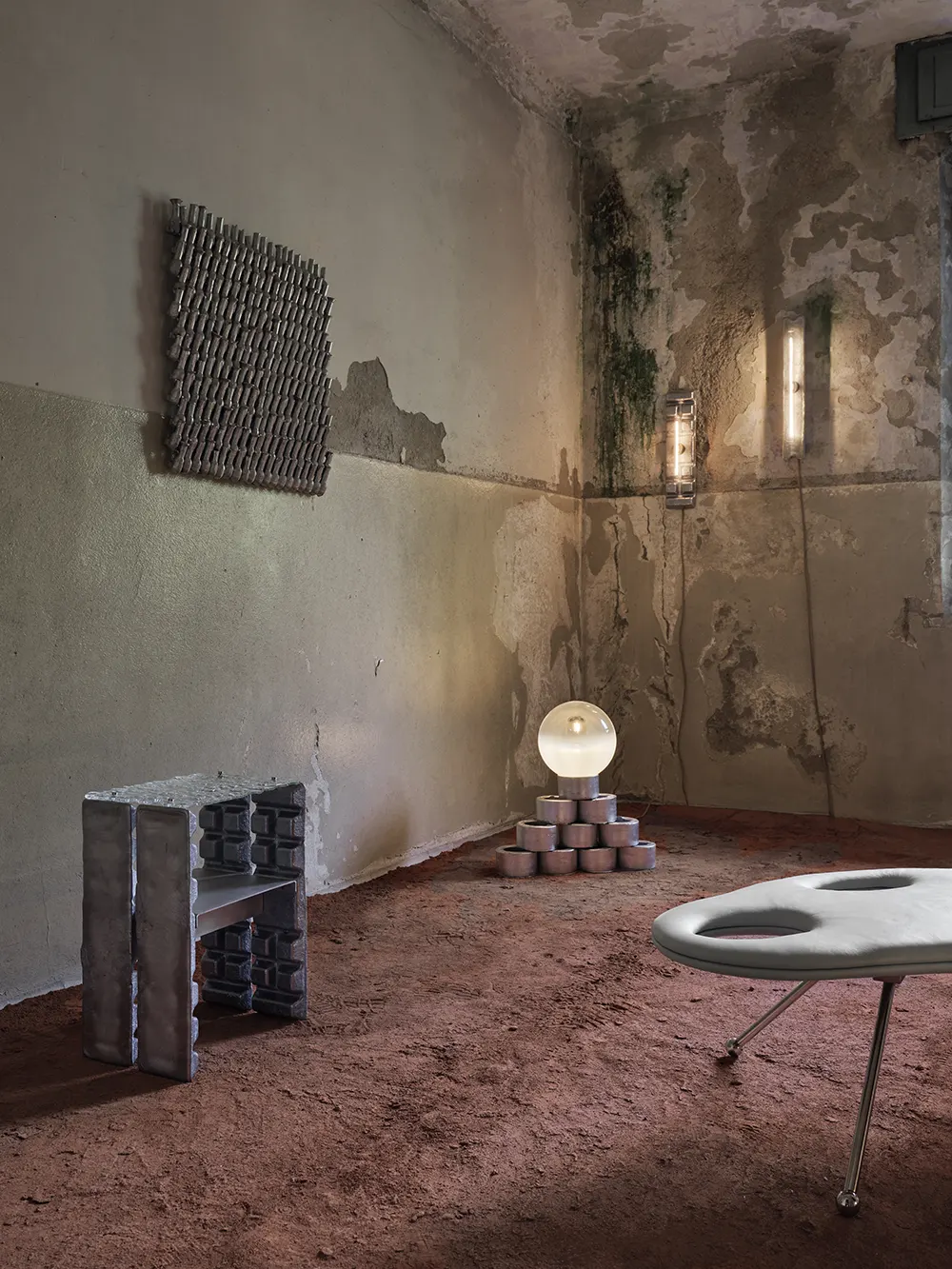
Between the red ground, the bespoke scent, and the lighting, the space took on a physical presence. How did you want people to feel while moving through it?
O: It is difficult to impose a specific emotion on people, and honestly, we never approached the exhibition that way. We were more interested in what we wanted to communicate rather than dictating how someone should feel. What we hoped for was a shift in perspective – a temporary shift away from everyday reality. We wanted to create an imagined context in which our objects could exist, almost as an invitation to meet somewhere else, on another planet. Maybe our reality on Earth is not always ideal, so we felt like there is something meaningful in imagining another beginning somewhere else. That idea was experienced physically as well. Instead of a hard floor, visitors suddenly felt soft brick dust beneath their feet, almost like sand. The atmosphere was intensified by the scent created by Mateusz Wójcik. How this affected perception probably depended entirely on personal experience, and the feedback was very diverse because of that. Some people said the floor reminded them of a tennis court – which very quickly revealed that they played tennis themselves. Others focused more on the soundscape, while people who immediately asked about materials and production techniques often turned out to be designers. I think that was the most interesting part – the exhibition became a space onto which visitors projected their own experiences, sensitivities, and associations.
M: It was very important for us to create a complete, immersive experience, so that when someone entered the space, they immediately felt transported somewhere unfamiliar, somewhere different from a typical exhibition environment. We wanted to introduce an element of surprise and slight uncertainty. Many visitors were unsure whether they were even allowed to step onto the Martian ground, and people became very curious about how the space was constructed and what the materials actually were. In that sense, the exhibition naturally generated questions and encouraged exploration. The scent also played a very important role because it instantly changed the atmosphere of the room and made the environment feel more emotional and physical. This kind of total sensory experience was one of the key ideas behind the exhibition.