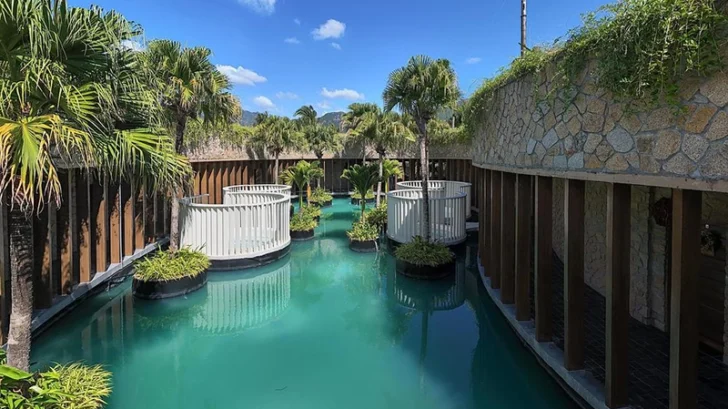

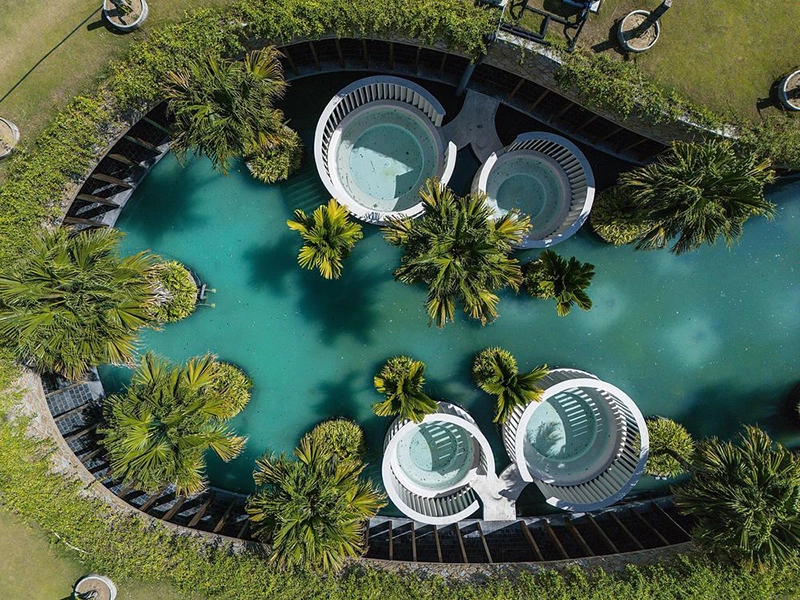
IDEE Architects approaches Hidden Spa – Water Hope with remarkable restraint. Located among the coastal sand dunes of Bãi Dài in Cam Ranh, Vietnam, the 3,000-square-meter wellness complex avoids the visual language commonly associated with luxury hospitality. Instead of creating a landmark, the practice conceals much of the building beneath the existing terrain, allowing the architecture to emerge gradually through landscape, water, and carefully controlled transitions between light and shade.
WELLNESS
This decision immediately distinguishes the project from many contemporary spa developments, where architecture often competes with its surroundings for attention. Here, IDEE Architects reverses that relationship. The dunes dictate the form of the building, and the architecture responds by following their contours rather than replacing them.
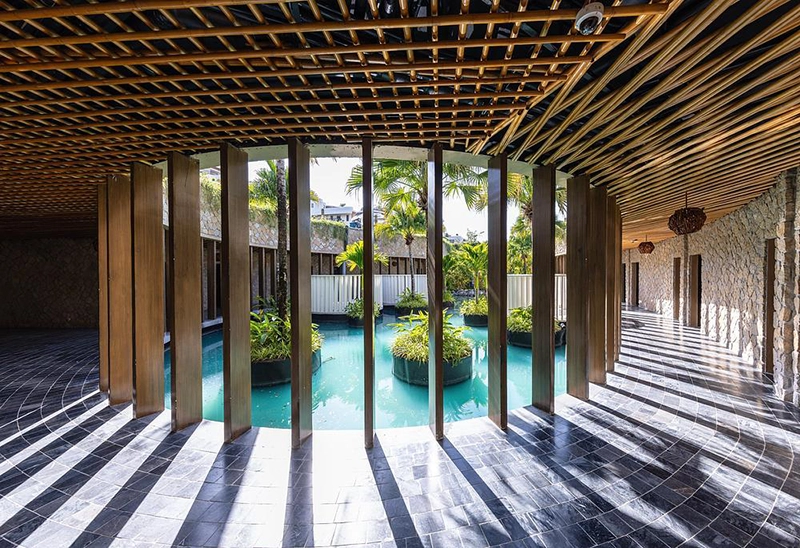
The site presented considerable environmental challenges. Strong coastal winds, tropical heat, and barren sand offered little protection from the climate. Rather than relying on mechanical systems to overcome these conditions, the architects developed a series of passive environmental strategies that work with the landscape. Water, vegetation, thermal mass, and natural ventilation become the project’s primary architectural tools.
A central water courtyard forms the heart of the complex. Reflecting pools, planted islands, and shaded circulation routes organize the visitor experience while simultaneously regulating the microclimate. Water performs multiple roles throughout the project. It cools surrounding spaces through evaporation, softens the harshness of the sandy landscape, reflects changing daylight, and introduces sound that reinforces the atmosphere of retreat. The courtyard succeeds because it never feels ornamental. Every pool contributes directly to the environmental performance of the building.
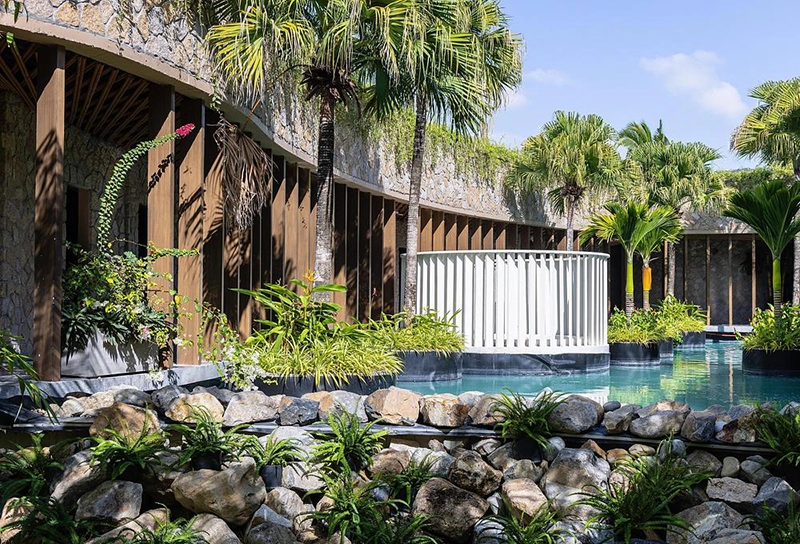
The building itself curves continuously around this central landscape. Its planted roof follows the profile of the surrounding dunes, allowing visitors to walk across what appears to be an uninterrupted extension of the terrain. By adapting to the site’s existing topography, IDEE Architects significantly reduces excavation while preserving the natural relationship between architecture and landscape. The building occupies the site without dominating it.
Material choices reinforce this measured approach. Locally sourced stone, timber, bamboo, and exposed concrete create an understated palette that responds naturally to the tropical climate. Thick stone walls provide thermal stability throughout the day, while open corridors and bamboo ceilings encourage continuous cross ventilation. The planted roof further limits solar heat gain, and rainwater collected from the sloping roof supports irrigation across the site.
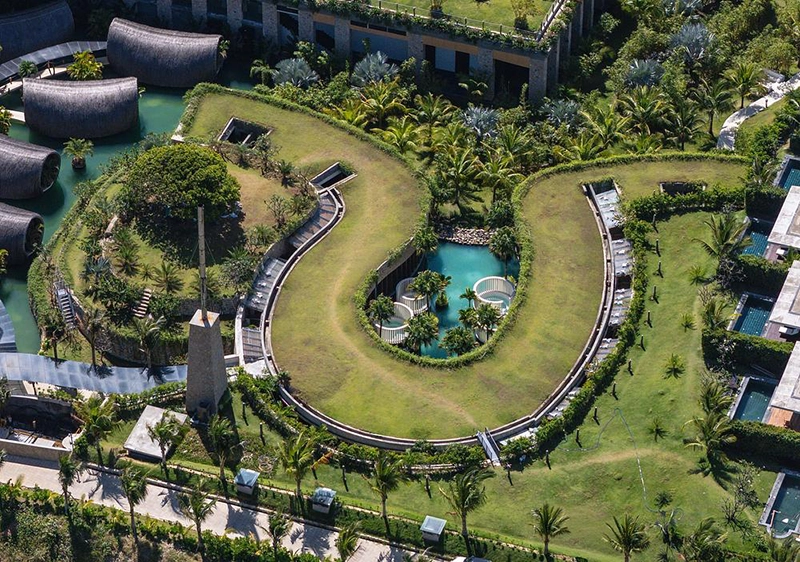
One of the project’s most compelling gestures centers on a mature tree that stood on the dunes before construction began. Instead of removing it to simplify the layout, IDEE Architects allowed the entire composition to develop around its presence. The tree becomes more than an existing condition to preserve. It anchors the project conceptually, symbolizing the larger ambition to regenerate the landscape rather than overwrite it.
That ambition extends beyond architecture into ecology. The introduction of water, planting, and shade has gradually transformed an exposed sandy environment into a functioning oasis. Vegetation now works alongside the architecture to moderate temperature, improve biodiversity, and strengthen the sensory qualities of the spa experience.
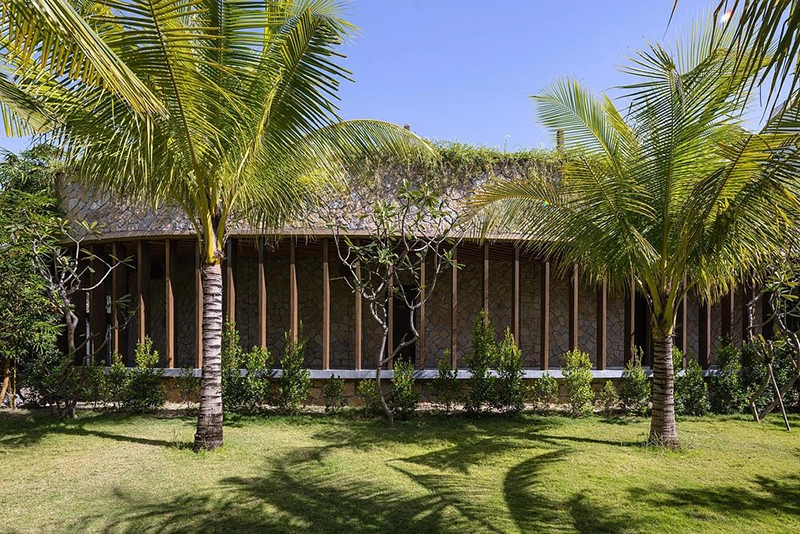
Hidden Spa – Water Hope also reflects a broader shift within contemporary tropical architecture. Increasingly, the strongest projects rely less on technological complexity and more on careful environmental planning. Passive cooling, natural ventilation, local materials, and landscape restoration replace highly engineered solutions without sacrificing comfort.
The project received the 2026 Architizer A+Awards Jury Winner in the Spa & Wellness category, recognition that reflects the clarity of its architectural thinking. While many wellness projects depend on visual spectacle, Hidden Spa finds its strength in atmosphere. IDEE Architects demonstrates that architecture can achieve presence through absence, allowing climate, water, vegetation, and topography to shape an experience that feels inseparable from its setting.