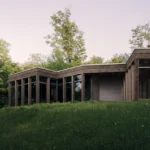

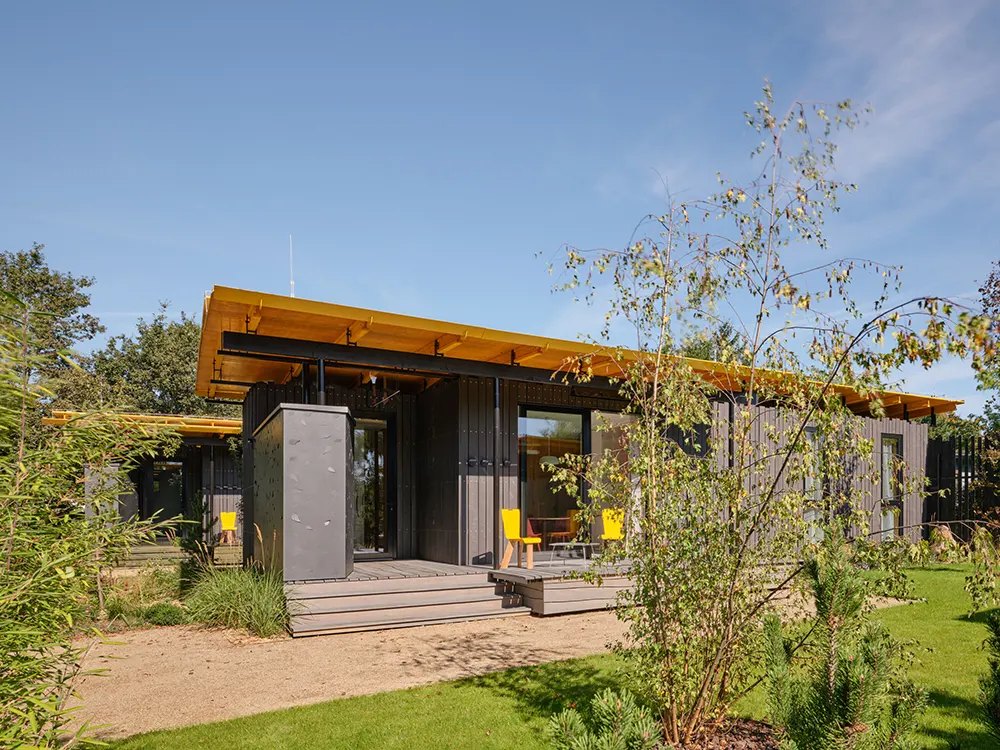
Studio Zlesart presents Bee House, a group of timber studio houses designed and built by Petr Novák on the edge of a town in the Vysočina region. Novák created the ensemble as a place for living and working close to nature, surrounded by mature trees that he planted on the site more than twenty years ago. The project grew over time, alongside the family business that gave it the technical and financial base needed for its completion.
RESIDENTIAL
The site once served as a slag dump for a nearby foundry. The family later transformed the land into a large garden, creating a quiet setting for long term rental studios. This change gives Bee House a strong sense of repair, with architecture, planting and daily use working within a site that carries an industrial past.
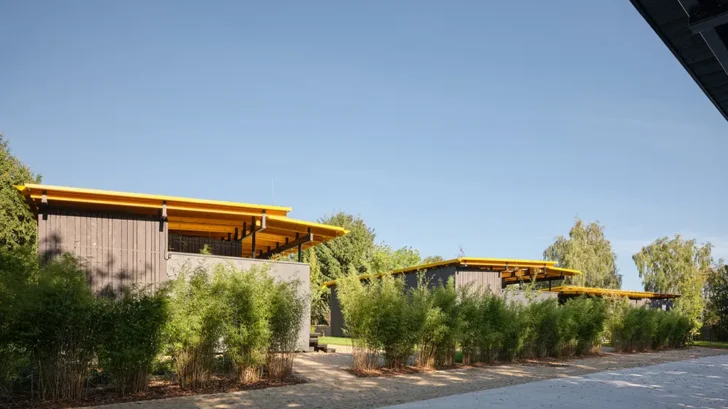
The timber houses draw from simple rural buildings and use materials with a direct connection to the region. A local timber manufacturer produced the shuttering boards and H beams that form the distinctive roofs. Builders usually use this structural system for monolithic concrete construction, yet Bee House leaves it exposed and marks it with yellow accents. The roofs give the ensemble a clear identity and create a vivid contrast with the dark oak facades. The team charred the exterior wood with the Shou Sugi Ban technique to increase durability and reduce maintenance.
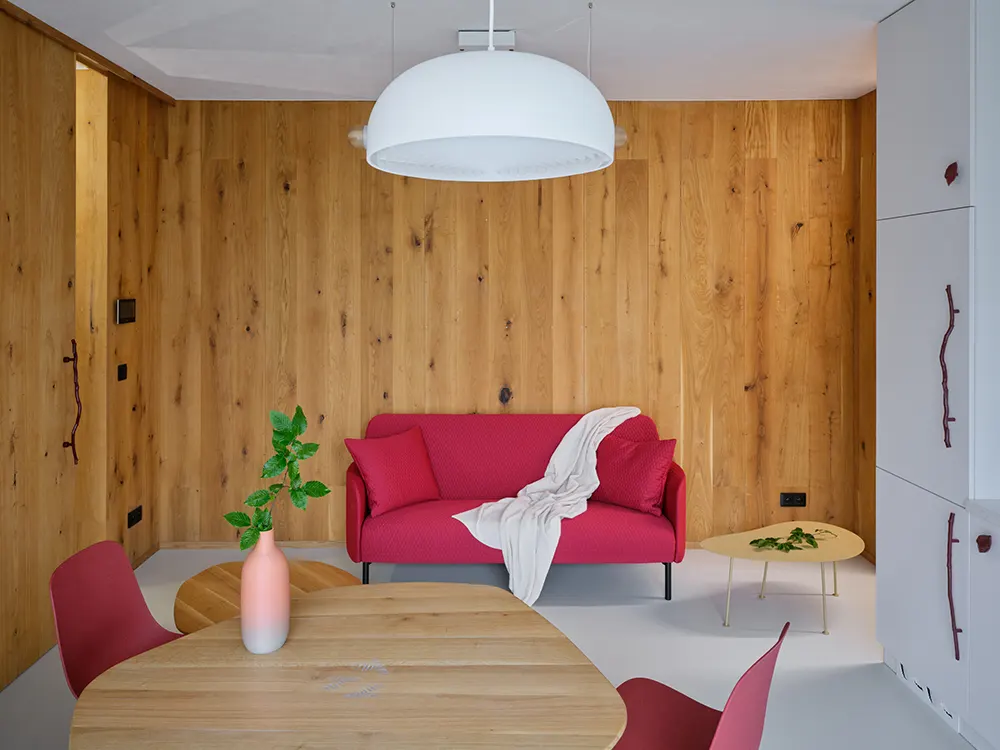
Inside, each studio uses an open layout, natural materials and large glazed openings that connect the rooms with the garden. A nearby sawmill produced oak lamellas for wall cladding, doors and interior elements. The team glued and pressed floor lamellas into particle boards, then used them as large wall panels measuring 2.7 by 1 meter. Sliding oak doors reach the ceiling and keep views open through the rooms. Yellow, red, grey and green color schemes give each studio its own identity.
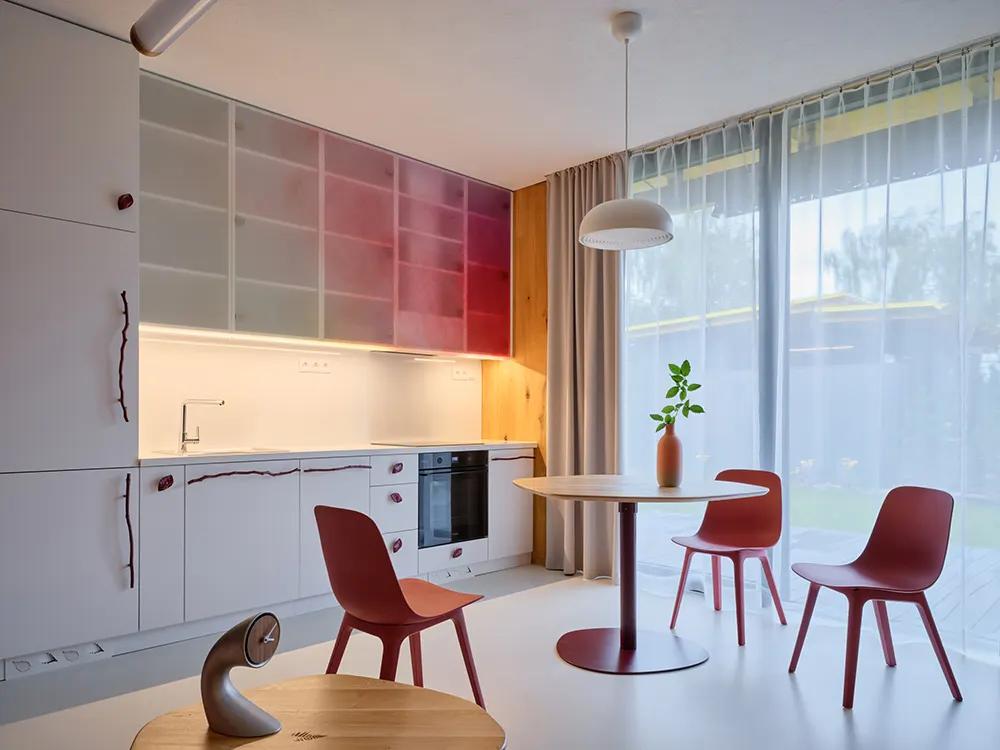
Novák also designed the kitchens, furniture, lighting and smaller details. A local foundry cast handles, door levers and other elements in brass and aluminum, using models made from beech branches, logs and leaves. Perforated metal leaves appear through the site, including on the entrance gate and a storage unit, giving the ensemble a repeated visual motif.
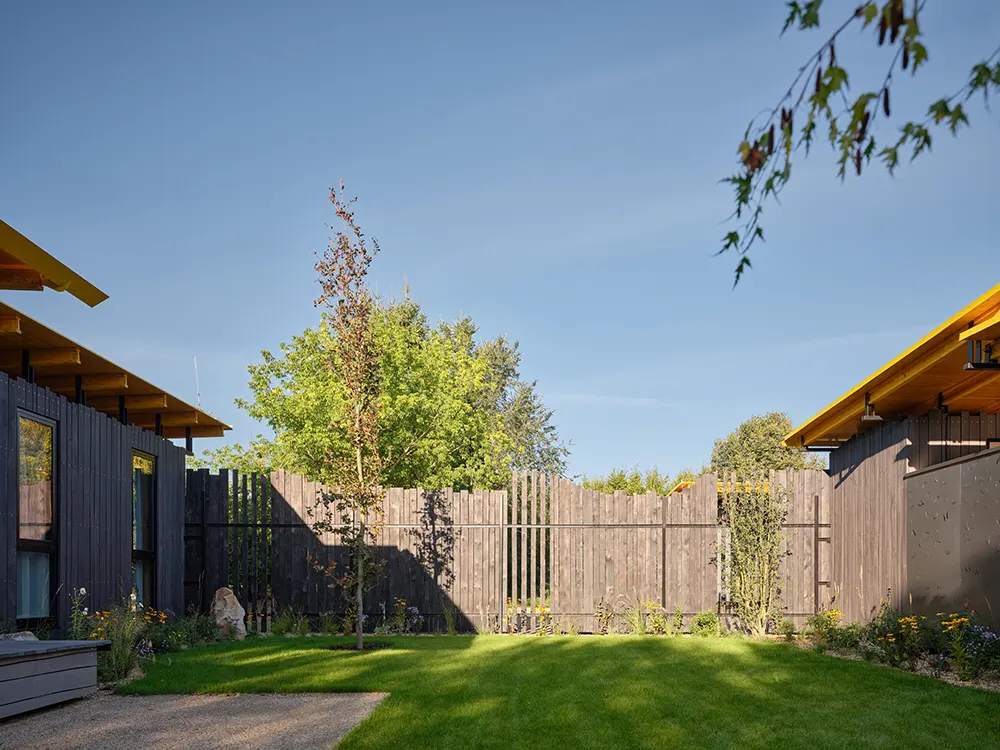
The compact layout gives residents privacy through the orientation of each house and its placement among trees. The plan also creates shared areas for the small community. Each studio has its own garden zone, shaped with perennials, ornamental grasses, solitary stones and charred wood fences. Planting connects the complex with its surroundings, while water from a local well irrigates the gardens.
The buildings stand on ground screws, which reduced disturbance to the terrain and allowed careful placement among the mature trees. Ochre gravel forms the paths in front of the studios. Terraces use organically shaped oak planks that continue the material language of the interior floors. Copper and steel light fixtures create subtle points of light across the site.
A shared parking area uses brushed concrete and Božanov sandstone paving, supporting the natural character of the complex. Residents also share a communal fire pit, while the plan includes a shared sauna and sports facilities for the future.
Studio: Zlesart
Author: Petr Novák
Co-author: Petr Myslivec [TAPA projekt]
Project location: Ždírec nad Doubravou, Czech Republic
Project year: 2024
Completion year: 2025
Gross floor area: 80 m²
Usable floor area: 58 m²
Plot size: 3350 m²
Cost: 480 000 €
Client: Petr Novák
Photographer: BoysPlayNice
Collaborators and suppliers
Landscape architect: Jan Kocourek
Structures, furniture: Modelárna Novák
Wooden structures, furniture: Truhlárna Michal Starý