
Zaha Hadid Architects introduces the Songshan Lake Exhibition and Performance Center in Dongguan, within the Greater Bay Area of southern China’s Pearl River estuary. The building forms a civic and cultural anchor within a mixed-use masterplan that aims to renew the Yuehe Lake waterfront. Its program supports national and international events, exhibitions and performances for visitors of all ages.
CULTURAL
The center began its public program with The Sound of Songhu. The China National Symphony Orchestra led the opening concert, establishing the building as a venue for music, theatre, visual culture, conferences and community activity.

Cantonese Opera shaped the center’s architectural language. The artform dates back more than 700 years to the Song Dynasty, and the region holds an important place in its history. ZHA drew from the flowing costumes that performers wear during productions, particularly the silk “water sleeves” that extend from their robes. Performers animate these sleeves through gesture to communicate emotion.
The building translates that movement into a group of distinct structures that rise, flare and build toward the western edge. These forms define the main theatre and exhibition spaces while giving the center a clear profile beside the water.
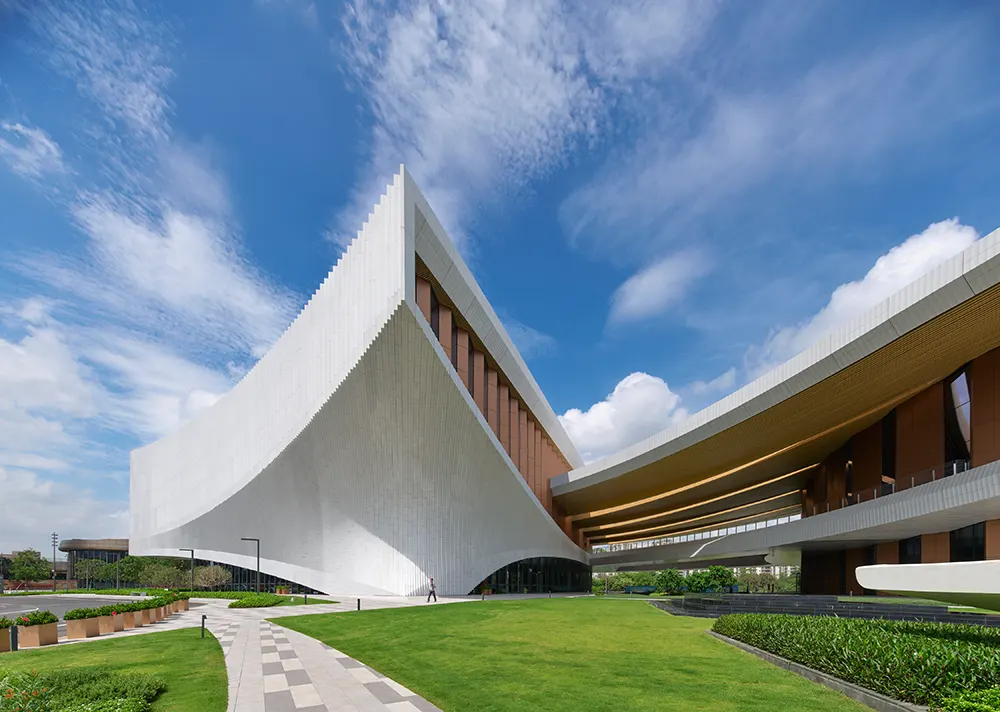
Traditional Lingnan architecture also informed the roof. Its broad overhang recalls the region’s upturned eaves and responds to Dongguan’s humid subtropical climate. The roof protects the building and its outdoor areas from sun and rain while allowing natural light to enter the interiors.
The design links multiple internal and external levels with sheltered public areas. A plaza, garden terraces and a waterfront promenade open the center toward Songshan Lake. Residents and visitors can use these spaces throughout the year, independent of the calendar of cultural events.
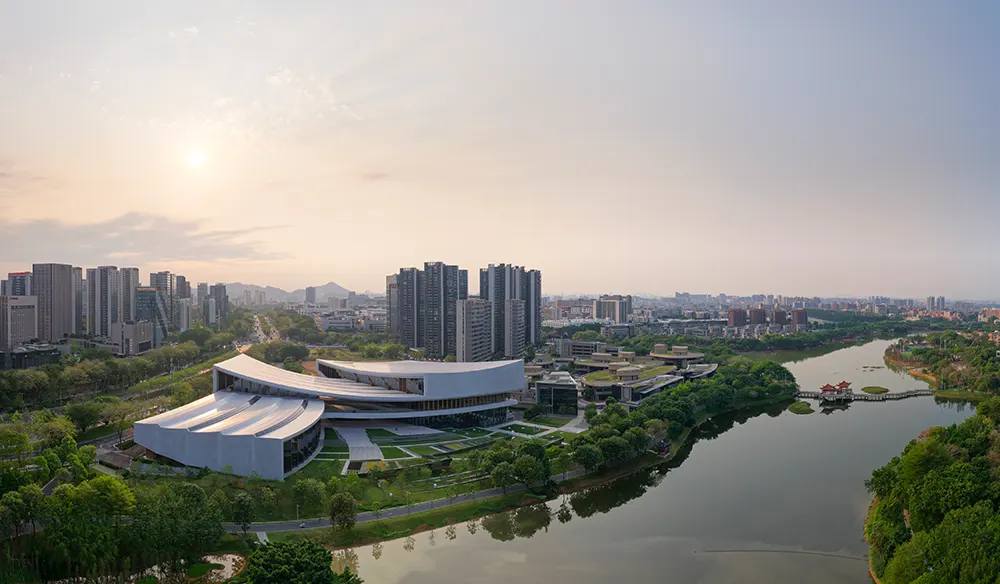
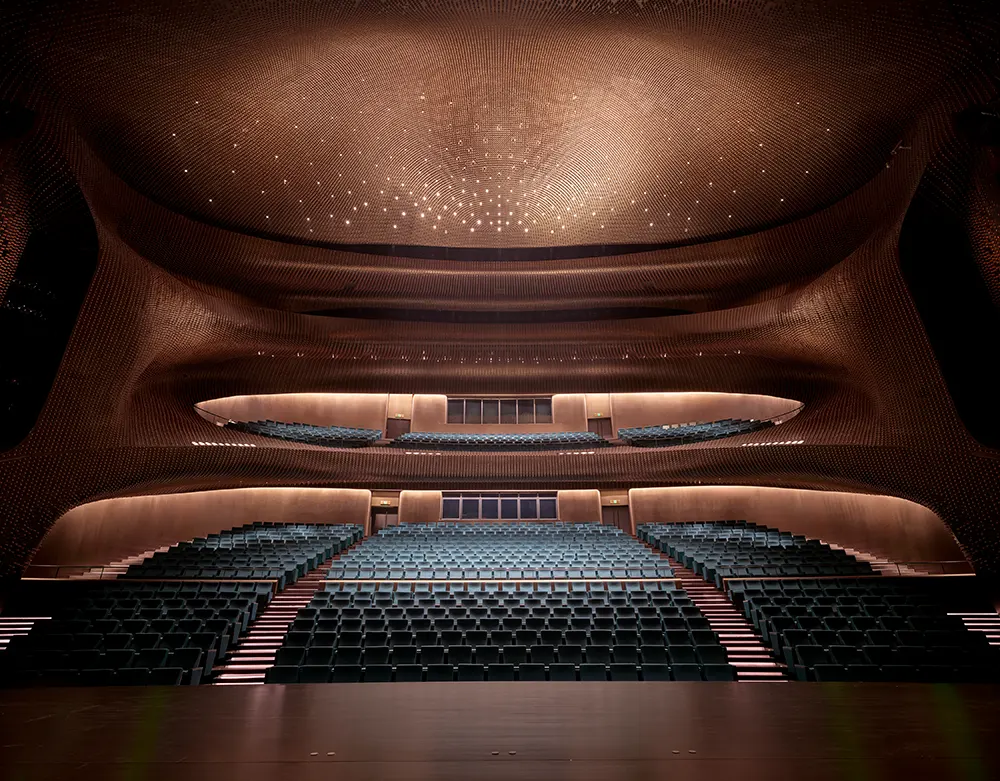
A 1,200-seat Grand Theatre supports large productions by local, national and international performers. The adjacent Exhibition Hall accommodates conferences, industry forums, art exhibitions and sporting competitions. A 400-seat Multifunction Hall provides a smaller setting for theatrical productions and children’s theatre.
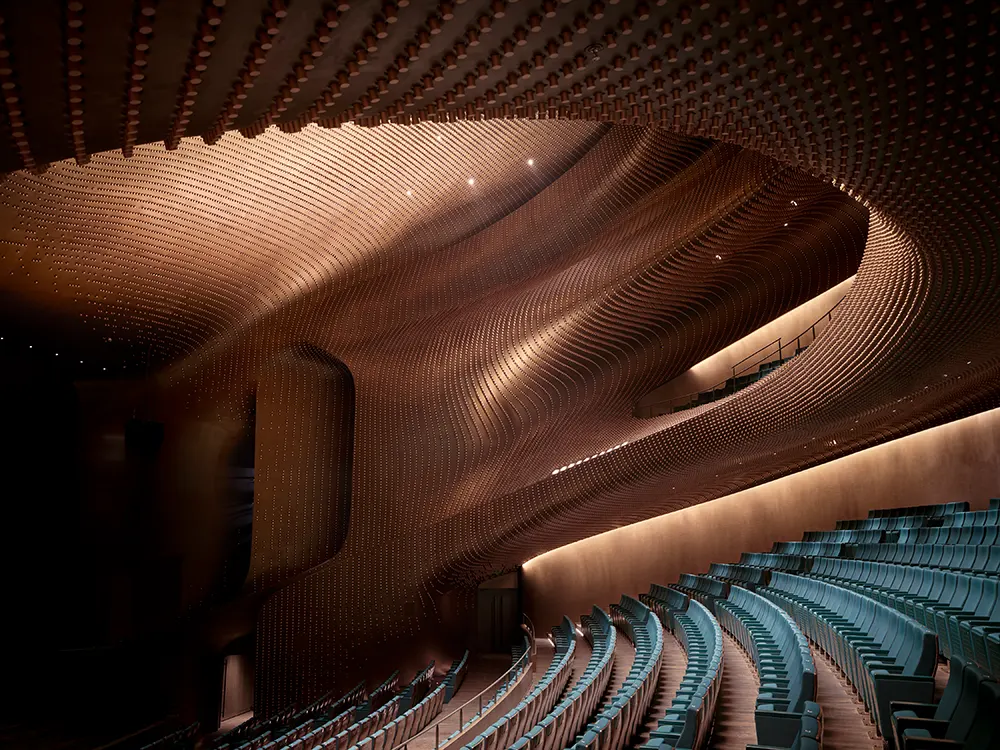
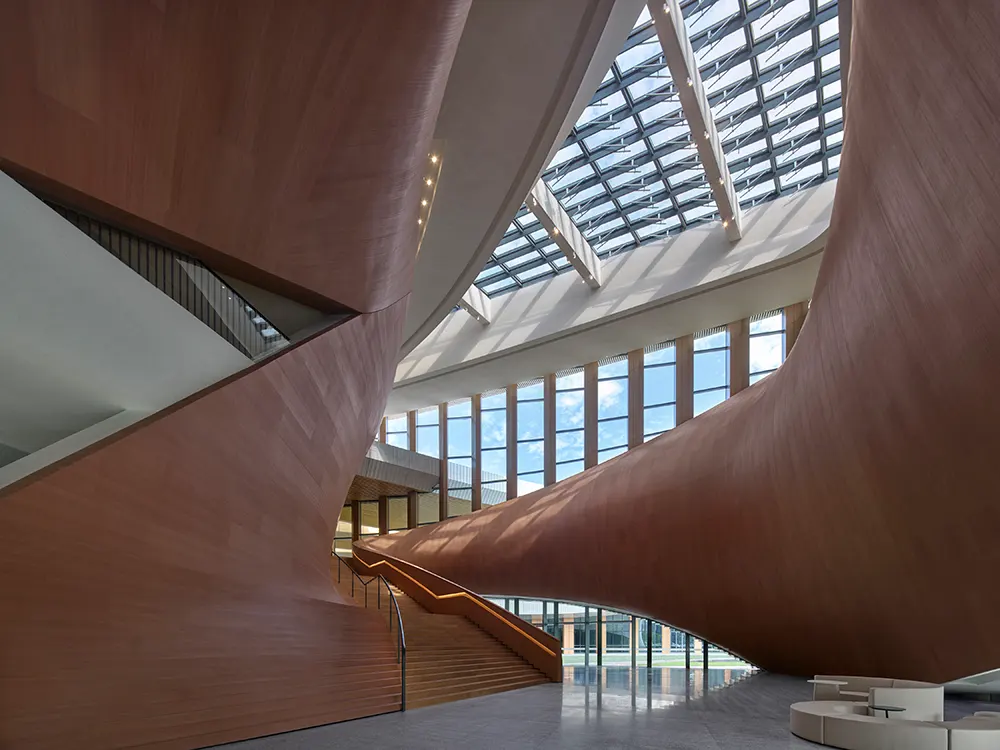
Acoustic design gives the Grand Theatre a highly specific interior character. The walls and ceiling carry 100,000 slender spines that diffuse sound, control reverberation and disperse standing soundwaves. Their varied lengths, densities and tones support clear, consistent sound throughout the auditorium. The shifting field of spines also creates a subtle visual rhythm around the seating.
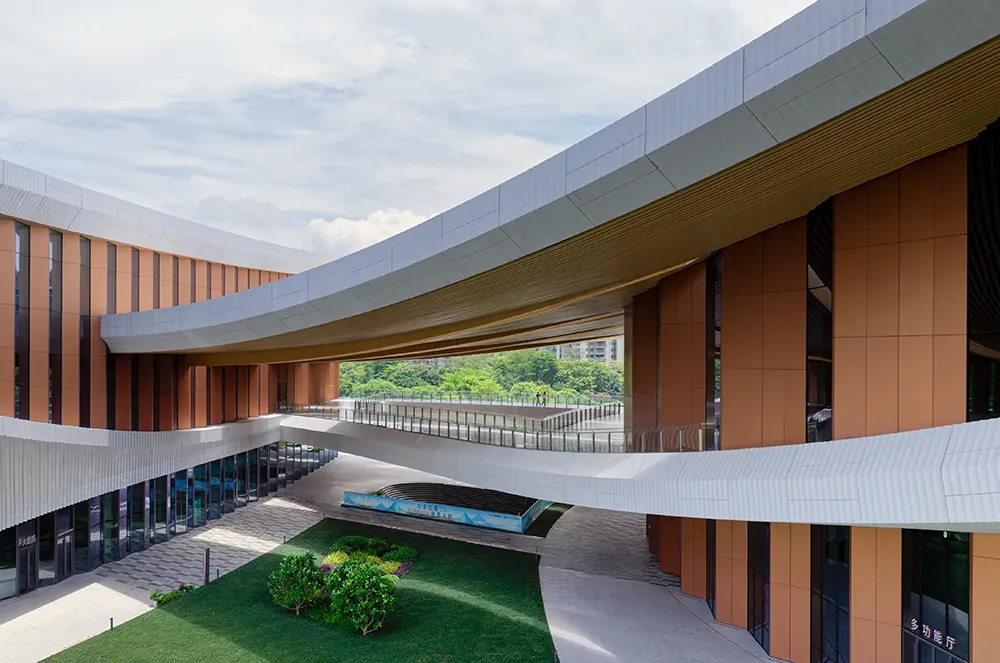
The project uses prefabrication and durable materials to reduce construction impacts. Crews used reusable molds to cast the ultra-high-performance concrete cladding, shortening construction time and reducing carbon emissions and waste. Prefabricated aluminum soffits and roof panels carry a light grey opalescent finish that limits solar heat gain at the low-latitude site.
Inside, aluminum and glass-reinforced gypsum support low-maintenance operation, extend the building’s life cycle and reduce embodied carbon. High-performance facades and intelligent HVAC management systems improve operational efficiency.
Photovoltaic arrays on the roof generate renewable energy on site, while rainwater harvesting lowers water use. Around the center, permeable surfaces and replanted wetlands help manage flood risk. The plaza, terraces and waterfront park also support local biodiversity while extending the center’s public role beyond its performance halls.

Project Team
Client: Dongguan Songshan Lake OCT Investment and Development Co., Ltd
Design Architect: ZHA
ZHA Principal: Patrik Schumacher
ZHA Project Director: Johannes Schafelner
ZHA Project Architect: Martin Krcha
ZHA Project Leads: Yifan Zhang, Evgeniya Yatsyuk, Gizem Muhtaroglu
ZHA Local Team: Shao-wei Huang (Head of Shenzhen Office) , Haohao Chen (Local Project Lead)
ZHA Technical Support: Branko Svarcer, Armando Solano
ZHA Project Team: Erfan Pour Ahmad, Mahyar Rakeei, Nazanin Sharif, Kourosh Asgar Irani, Genci Sulo, Hazel Ozrenk, Chiara Baiocco, Dennis Brezina, Alessandra Lazzoni, Nassim Eshaghi, Xuanzhi Huang, Tommaso Casucci, Fangxingchi Du, Florentine Rockenbauer
ZHA Competition Project Directors: Johannes Schafelner, Shao-wei Huang, Charles Walker
ZHA Competition Project Architects: Ashwin Shah, Yifan Zhang
ZHA Competition Team: Valeria Mazzilli, Erfan Pour Ahmad
Photography: Virgile Simon Bertrand